


Light That Helps You Heal: A Simple Guide to Photobiomodulation
Light That Helps You Heal: A Simple Guide to Photobiomodulation
Pradeep Chopra, MD
This article is for information only. It does not constitute as medical advice. I do not have any conflict of interest with the any manufacturer or product.
Have you ever felt the warm sun on your face and thought, "This feels good"? Sunlight does more than warm us up. Certain colors of light can also help our cells work better. Doctors and scientists call this photobiomodulation, or PBMfor short.
It is a big word, but the idea is simple. Photo means light. Bio means life. Modulation means to change or adjust. So PBM means using light to adjust how living cells behave.
What Is Photobiomodulation?
In PBM, a small device shines gentle red or near-infrared light on the skin. The light is not hot. It does not burn or cut. You can usually feel only a little warmth, or nothing at all.
The light passes into the body and reaches the cells underneath. There it gives the cells a boost, a bit like charging a phone battery.
How Does It Work?
Every cell in your body has tiny parts called mitochondria. They are the cell's power plants. They make a fuel called ATP. Your muscles, nerves, and brain all need ATP to do their jobs.
Inside the mitochondria is a special protein called cytochrome c oxidase. It works like a little antenna. When it takes in red or near-infrared light, three helpful things can happen:
1. More energy. The mitochondria can make more ATP.
2. Better blood flow. The light helps release a gas called nitric oxide. This gas can relax blood vessels so more blood and oxygen reach the area.
3. Calmer inflammation. Light can help turn down some of the signals that cause swelling and soreness.
When cells have more energy and better blood flow, they can repair themselves more easily.
What is red light therapy?
Red light therapy uses special lights to help your body heal. Doctors and scientists call it photobiomodulation. That is a big word. Let us break it down:
• Photo means light.
• Bio means life.
• Modulation means change.
So photobiomodulation means "using light to change how living cells work." The light does not burn or tan your skin. It does not use the harmful UV rays that come from the sun. Instead, it uses gentle red light and near-infrared light. You can see red light. You cannot see near-infrared light, but your body can feel its effects.
How does it work?
Your body is made of trillions of tiny cells. Inside each cell are even tinier parts called mitochondria. Think of them as little batteries. They make the energy your cells need to grow, fix damage, and stay healthy.
When red and near-infrared light shine on your body, some of the light soaks into your cells. The mitochondria take in this light. Scientists think this helps the batteries make more energy, called ATP. It may also help calm swelling and help blood flow better.
Here is a simple way to think about it. A plant uses sunlight to make food. Your cells cannot make food from light. But the right kind of light may give your cell batteries a small boost. When cells have more energy, they can do their repair jobs better.
I spent some time investigating companies that manufacture LEDS lights for photobiomodulation. The best I could come up with is stated below. I absolutely have no conflict of interest with this company or any company.
Meet the Platinum LED lights
PlatinumLED is a company in Hawaii that makes red light therapy panels. Their main lights are called BIOMAX. Each BIOMAX panel shines seven different colors of light at the same time. Scientists measure light color in nanometers, or "nm" for short. A smaller number means bluer light. A bigger number means redder light, or light you cannot see at all.
Light series
Who it is for
Light colors (nm)
BIOMAX (9th generation)
Home users
480, 630, 660, 810, 830, 850, 1060
Clinics, athletes, and people who want more power (about 50% more light energy than BIOMAX)
480, 630, 660, 810, 830, 850, 1060
People with a sauna
480, 630, 660, 810, 830, 850
The company says its BIOMAX lights are FDA Class II medical devices. It also says its lights are safety tested and have no harmful EMF. One fair thing to know: independent testers found that most of the light from a BIOMAX panel comes from just two colors, 660 nm and 850 nm. That is about three out of every four parts of the light. The blue (480 nm) and 1060 nm lights are much weaker. This is not bad news. Those two main colors are the ones scientists have studied the most.
How deep does each light go?
The deeper the light goes, the deeper the body part it can help. Blue light stays near the top. Near-infrared light goes the deepest.
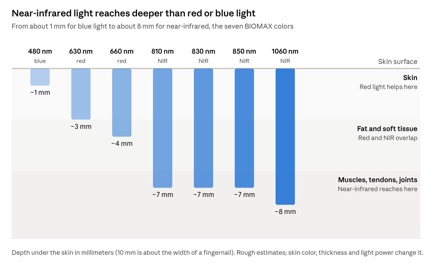
Approximate useful depths drawn from published light-in-tissue research; real depth varies by person and device. Wavelengths: PlatinumLED BIOMAX spec, October 2026.
Think of light like a flashlight shining into your hand. A little light gets through, and most of it fades along the way. Blue light fades fast, so it only works on the very top of the skin. Red light reaches the deeper skin, where it helps skin heal and make collagen. Near-infrared light (NIR) travels the farthest, toward muscles, tendons, and joints. That is why near-infrared light is used for sore muscles and achy joints. Only a small part of the light reaches the deepest point, so the right power and time matter.
Why Wavelength Matters
This part is very important. Not every color of light works the same way.
Light is measured in nanometers (nm). One nanometer is about one billionth of a meter. Each color of light has its own number, and that number is called its wavelength.
PBM works best in a range called the optical window. It runs from about 600 to 1100 nm. Here is why that range is special:
• Red light (about 630 to 670 nm) is good for the skin and for tissue close to the surface. It reaches only a few millimeters deep.
• Near-infrared light (about 800 to 850 nm) goes deeper. It can reach muscles, joints, and nerves. You cannot see it with your eyes.
• Light below 600 nm, like blue and green, is mostly blocked by blood and skin. It does not travel deep.
• Light above 1100 nm is soaked up by water in the body. Mostly it just heats the skin.
Think of it like a key and a lock. The cell's antenna can only "catch" certain colors. If the wavelength is wrong, the light may bounce off, get absorbed by the wrong thing, or just make heat. The cells do not get the message.
The dose matters too. PBM follows a rule called a biphasic dose response. A small amount of light helps. A medium amount helps the most. Too much light can make the benefit smaller or even disappear. More is not always better.
How Can PBM Help With Pain?
Pain often comes from sore muscles, stiff joints, or irritated nerves. PBM may help in a few ways:
• It can calm inflammation in the sore area.
• It can bring more blood and oxygen to tired tissue.
• It can give damaged cells the energy they need to heal.
• It may change how nerves send pain signals.
Studies suggest PBM may help with some kinds of pain. These include knee arthritis, neck pain, tendon problems, and mouth sores from cancer treatment. The results are not the same for every person or every condition. Still, many people find it helpful as one part of a pain plan.
How Can PBM Help With Fatigue?
Fatigue is more than feeling sleepy. It is a deep tiredness that rest does not fix. Since PBM can help mitochondria make more energy, scientists are curious about whether it can help people who feel worn out all the time.
Early studies in people with long-term pain or cancer-related tiredness look hopeful. Some people report more energy and better daily function. This research is still growing, though. We need larger and better studies before we can say how well it works.
Is It Safe?
For most people, PBM has few side effects. Here are some tips:
• Protect your eyes. Use proper goggles, especially with strong devices. Never stare into the light.
• Follow the instructions. Use the right amount of time and distance.
• Choose a quality device. Make sure it lists its wavelengths and power. If it does not, be careful.
• Talk to your doctor first. This matters most if you are pregnant, have cancer, take medicines that make you sensitive to light, or have a skin problem in the area.
The Bottom Line
Photobiomodulation uses red and near-infrared light to help cells make more energy, improve blood flow, and calm inflammation. The right wavelength and the right dose are the keys to making it work. It is not a miracle cure, but it may be a safe and useful tool for some people with pain and fatigue.
If you are curious, ask your health care provider whether PBM could fit into your care plan.
Disclaimer:
The information provided on this website is intended for informational purposes only and should not be considered a substitute for professional medical advice, diagnosis, or treatment. It is also not intended to serve as legal advice or replace professional legal counsel. While efforts have been made to ensure the accuracy of the information, there is no warranty regarding its completeness or relevance to specific medical and legal situations. As medical information continuously evolves, users should not rely solely on this information for medical or legal decisions and are encouraged to consult with their own physician or qualified attorney for any legal matters or advice.
Copyright 2025 Pradeep Chopra. All rights reserved.
More insights from the experts

The information provided on this website is intended for informational purposes only and should not be considered a substitute for professional medical advice, diagnosis, or treatment. It is also not intended to serve as legal advice or replace professional legal counsel. While efforts have been made to ensure the accuracy of the information, there is no warranty regarding its completeness or relevance to specific medical and legal situations. As medical information continuously evolves, users should not rely solely on this information for medical or legal decisions and are encouraged to consult with their own physician or qualified attorney for any legal matters or advice.